The Greatest “What If” in Martial Arts History
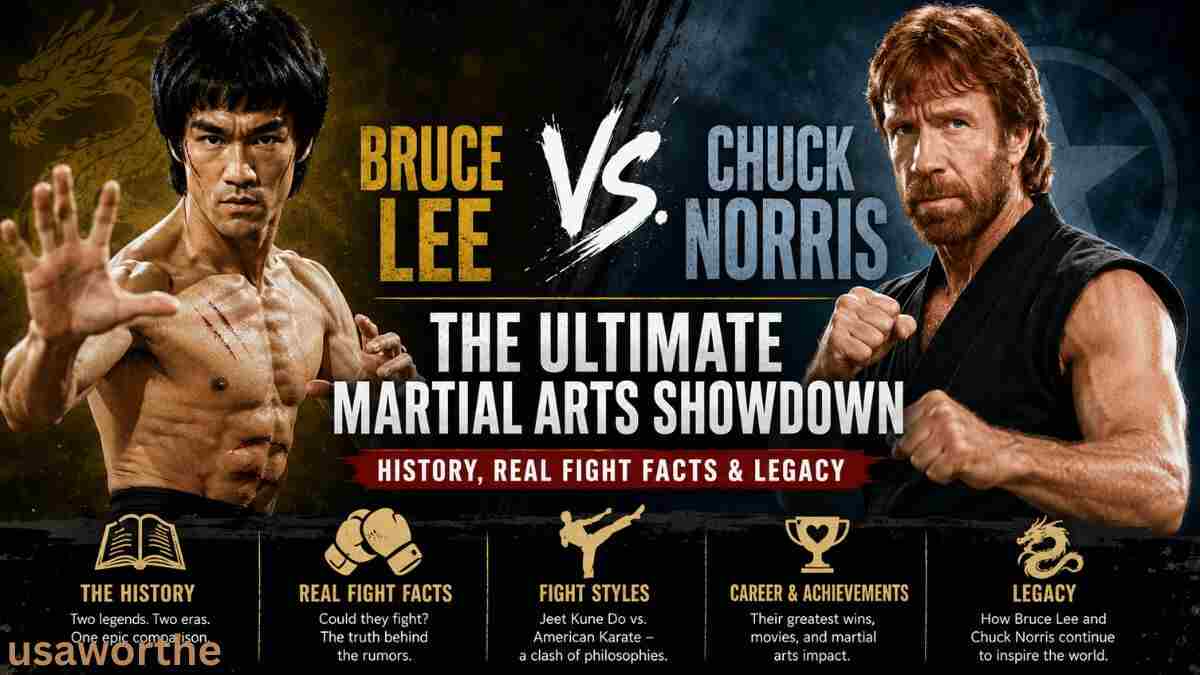
No debate in the history of martial arts has burned longer or generated a more passionate argument than this one: Bruce Lee vs. Chuck Norris — who would win in a real fight?
The question has outlived both men. Bruce Lee died in 1973 at just 32 years old, at the absolute peak of his powers. Chuck Norris, the martial arts champion who became an iconic action star and led the hit series Walker, Texas Ranger, died on March 19, 2026, at the age of 86, following a sudden medical emergency in Hawaii. His family released a statement on Instagram confirming his death and asking for privacy as they mourned his loss.
Their deaths, separated by 53 years, bookend one of the most extraordinary friendships in combat sports history — and one of the most iconic fight scenes ever captured on film. This article covers who these men were, how they met, what actually happened when they trained together, what the Colosseum fight reveals about both of them, and what the honest evidence says about who would have won if the gloves had ever come off for real.
Quick Comparison: Bruce Lee vs. Chuck Norris
| Category | Bruce Lee | Chuck Norris |
|---|---|---|
| Full Name | Lee Jun-fan | Carlos Ray Norris |
| Born | November 27, 1940 | March 10, 1940 |
| Died | July 20, 1973 (age 32) | March 19, 2026 (age 86) |
| Birthplace | San Francisco, California | Ryan, Oklahoma |
| Primary Style | Jeet Kune Do (Wing Chun base) | Tang Soo Do / Chun Kuk Do |
| Secondary Skills | Boxing, fencing footwork, wrestling | Karate, Taekwondo, BJJ, Judo |
| Tournament Record | Not a competitive fighter | 168 wins, 2 draws (1968–74) |
| Major Title | None (exhibition/demonstration fighter) | 6x World Karate Champion |
| Famous Film | Enter the Dragon (1973) | Walker, Texas Ranger (1993–2001) |
| Known For | Speed, Jeet Kune Do philosophy | Roundhouse kick, cultural icon |
Who Was Bruce Lee?
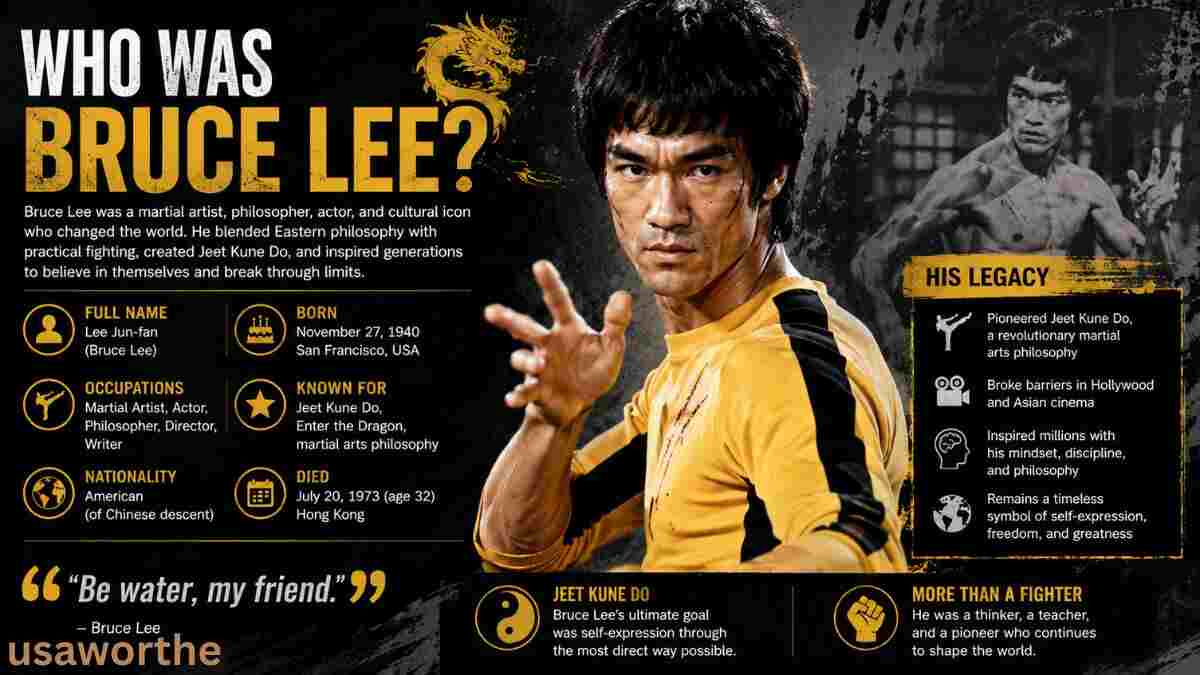
Bruce Lee was not merely a martial artist or a movie star. He was a philosopher of combat — a man who studied every existing martial art, extracted what worked, discarded what did not, and built something entirely new.
Born in San Francisco on November 27, 1940, and raised in Hong Kong, Lee began studying Wing Chun kung fu at age 13 under the legendary Ip Man. He supplemented this with Western boxing, fencing, footwork, and wrestling, eventually synthesizing everything into his own system: Jeet Kune Do — “The Way of the Intercepting Fist.”
The philosophy behind Jeet Kune Do was radical for its time: no fixed forms, no rigid techniques, no loyalty to a single style. “Using no way as way, having no limitation as limitation,” as Lee himself put it. UFC President Dana White later said Lee’s approach — taking the best from every discipline and discarding the rest — is essentially a definition of modern mixed martial arts, which is why Lee is widely credited as the intellectual father of MMA.
Bruce Lee’s Physical Conditioning
At 5’7″ and approximately 135 lbs in his prime, Lee’s physical conditioning was extraordinary even by modern standards. He ran, cycled, stretched, and practiced his techniques thousands of times per session. His one-inch punch — capable of sending a full-grown man flying backward from minimal distance — became one of the most studied examples of power generation in martial arts science.
As Chuck Norris himself stated: “Lee was lightning fast, very agile and incredibly strong for his size.” Multiple training partners reported that Lee’s strikes were genuinely difficult to track — that the hand had already made contact before the eye could register the movement.
What Lee lacked was a competitive record under formal tournament conditions. He participated in very few sanctioned bouts, preferring exhibitions and demonstrations. His most famous real fight — against Northern Shaolin practitioner Wong Jack Man — was a private affair that, by some accounts, pushed Lee hard enough to rethink his physical conditioning entirely.
Who Was Chuck Norris?
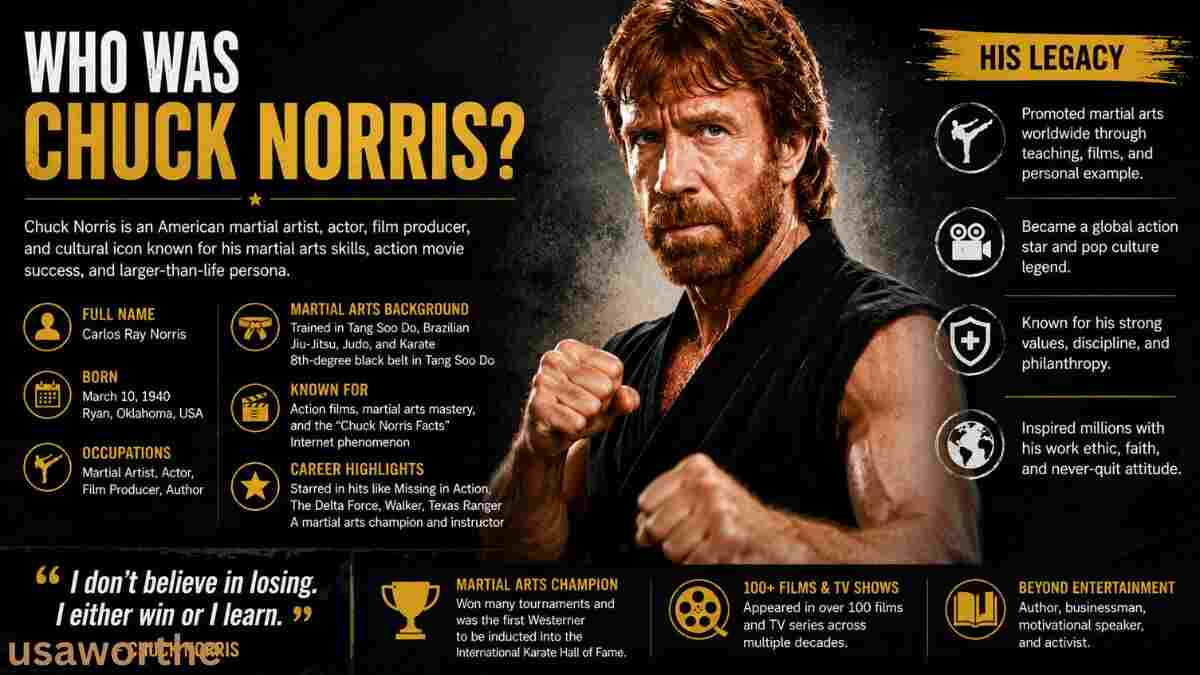
Carlos Ray “Chuck” Norris held black belts in karate, taekwondo, Tang Soo Do, Brazilian jiu-jitsu, and judo. After serving in the United States Air Force, he won numerous martial arts championships and later founded his own discipline, Chun Kuk Do.
Where Lee was the philosopher-artist of martial arts, Norris was its champion-competitor. He did not theorize about fighting — he competed and won, consistently, under pressure, in front of judges, for a decade.
In the 1960s, he became a karate instructor and an owner of over 30 karate schools, while also building a career as one of the most dominant fighters in the sport. Black Belt magazine’s Hall of Fame recognized Norris with a 10th degree black belt — the highest honor in martial arts.
Chuck Norris’ Competitive Record
Norris competed from 1964 to 1974. After losing his first two professional bouts, he rebuilt and went on a run that remains one of the most dominant in competitive karate history. He won six consecutive World Professional Middleweight Karate Championships, compiling a career record of 168 wins and just 2 draws over that span (Grunge).
His signature weapon was the spinning roundhouse kick — one of the most recognizable techniques in martial arts. His celebrity training clients during this period included Steve McQueen, Bob Barker, and Priscilla Presley. It was McQueen who encouraged Norris to take acting seriously — a nudge that redirected his entire career.
How Bruce Lee and Chuck Norris Met
Bruce Lee and Chuck Norris first crossed paths at a martial arts demonstration in Long Beach, California in 1964. Both were rising names in their respective worlds. The two met again at a karate tournament in the late 1960s and became friends, and for a period of about two years, Lee and Norris trained and worked out together in Lee’s backyard in Los Angeles.
In an Instagram video shared by Bruce Lee’s official account, Norris described their sessions: “We worked out in his backyard and he had a bag back there. So we did a lot of punching, a lot of kicking, and we did a lot of exercises, lots of push-ups, lots of sit-ups, a LOT of sit-ups. But the thing is Bruce was a very rare type of individual. Exercise and conditioning was his life.”
The training partnership only ended when Lee relocated to Hong Kong to begin his film career.
What Norris Learned — and What He Taught Lee
The training sessions were genuinely mutual. Norris has said that Lee, at the time, believed a martial artist should never kick above the waist. Norris disagreed, explaining that “you should be able to kick anywhere,” and demonstrated his range of high kicks. Lee took the advice seriously, and within six months his high kicks had improved dramatically.
As Norris later summarized: “Bruce Lee learned from everybody. He had a very open mind. He never believed in only one martial arts style or that one was superior. He believed that everything had strengths and weaknesses and that we should find the strengths in each method.”
Norris’ admiration for Lee was unambiguous. He stated publicly: “The truth is Lee was a formidable opponent with a chiselled physique and technique. I totally enjoyed sparring and just spending time with him. He was as charismatic and friendly in the ring and at home as he was on film. His confidence and wit were dazzling, and sometimes even debilitating to others.”
The Way of the Dragon (1972): The Colosseum Fight
How the Scene Came Together
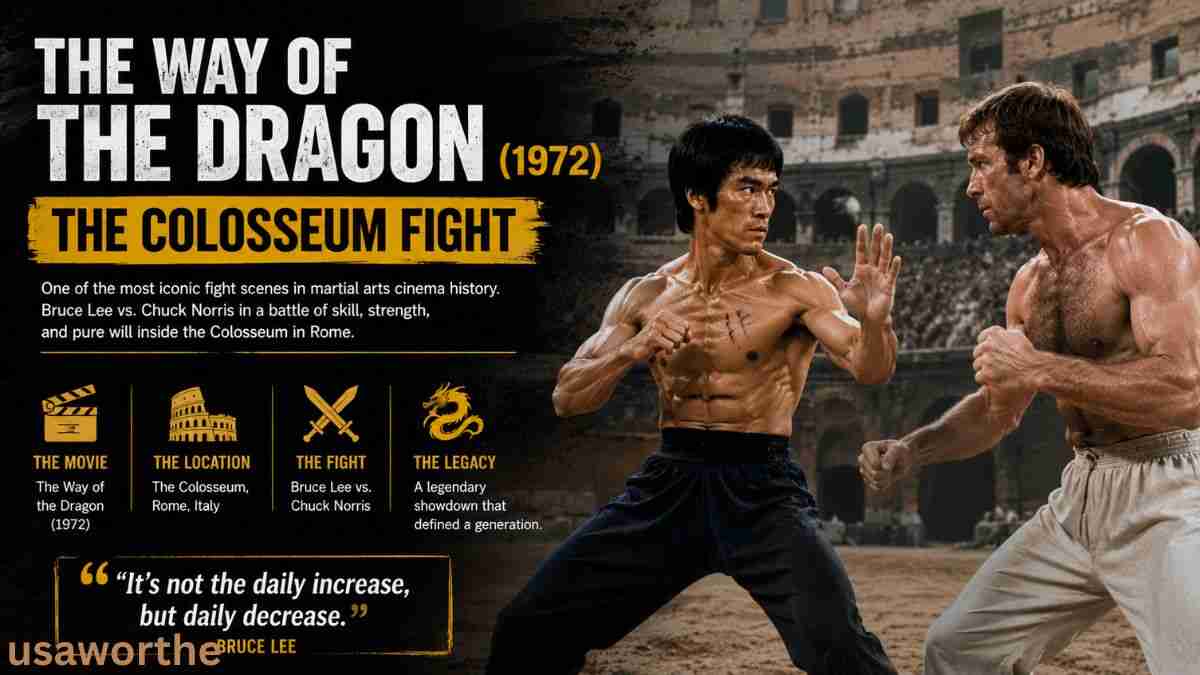
In 1972, Lee cast Norris as the villain Colt in The Way of the Dragon — his third Hong Kong film and the one in which he had complete creative control over writing, directing, and fight choreography. Lee had originally wanted karate and kickboxing expert Joe Lewis for the role, but when Lewis was unavailable, he turned to Norris.
Lee called Norris with the pitch: “I’m going to do a fight scene in the Colosseum in Rome, like two gladiators fighting.” When Norris asked who would win, Lee’s first answer was direct: “I win. I’m the star of this movie.” He then refined it: “No — I want to kill the world champion.”
Lee had been inspired by the 1960 historical epic Spartacus and saw the ancient Roman venue as the perfect backdrop for a physical clash of civilizations — East versus West, kung fu versus karate, philosophy versus raw competitive power.
The Unauthorized Shoot
Filming the Colosseum sequence presented a significant legal obstacle: shooting inside the Colosseum is prohibited. Lee and his crew had to bribe local officials and enter the venue with cameras concealed in tourist bags, pretending to be ordinary visitors. Even major productions — including Gladiator — have had to build replica sets rather than film in the actual arena.
The vast majority of the fight unspools as it happened, filmed in the actual Colosseum. Additional shots were completed in a Hong Kong studio, but the core sequence is real footage from the unauthorized shoot.
The Fight Scene Itself
The sequence runs nearly ten minutes — an eternity by the standards of action cinema. It opens with mutual respect: both characters stretch, size each other up, and acknowledge the quality of their opponent. Then it escalates, methodically and with a level of physical authenticity rarely seen on screen. The sequence showed Lee and Norris making actual contact with several of their strikes.
During the fight, Lee demonstrated what would later be recognized in MMA circles as the oblique kick — a technique now used regularly in the UFC, most notably by pound-for-pound champion Jon Jones, who has cited Lee as an influence.
The sequence ends with Lee’s character delivering a finishing hold to Norris’ character — followed by a moment of genuine tenderness, as Lee’s character mourns the death of a worthy opponent. It remains one of the most emotionally resonant endings to any fight scene in film history.
Box Office Impact
Against a production budget of approximately $130,000, The Way of the Dragon grossed an estimated $130 million worldwide — roughly 1,000 times its cost. It was the highest-grossing Hong Kong film of its era until Lee’s next project, Enter the Dragon (1973). The film holds an 87% approval rating on Rotten Tomatoes.
Fighting Styles: A Head-to-Head Breakdown
| Factor | Bruce Lee (Jeet Kune Do) | Chuck Norris (Tang Soo Do / Chun Kuk Do) |
|---|---|---|
| Speed | Elite — “lightning fast” per Norris himself | Fast, but not in Lee’s category |
| Power | Exceptional for his size (one-inch punch) | Renowned for devastating roundhouse kicks |
| Grappling | Limited — Jeet Kune Do is stand-up focused | Black belt in BJJ and Judo |
| Ground Game | Weak — not addressed in Jeet Kune Do | Stronger — multiple grappling disciplines |
| Tournament Experience | None in formal competition | 168 wins, 2 draws; 6x World Champion |
| Real-Fight Adaptability | Very high — style designed for real-world combat | Moderate — style optimized for competition rules |
| Signature Technique | One-inch punch; oblique kick | Spinning roundhouse kick |
| Mental Composure | Intense, competitive | Calm, methodical, highly experienced under pressure |
Who Would Win in a Real Fight? The Honest Breakdown
This is the question every reader came here for. The honest answer is: nobody knows — and that ambiguity is precisely why this debate has lasted more than 50 years.
The Case for Bruce Lee
Lee’s speed advantage was real and extensively documented. Every person who trained with him — including Norris — confirmed that his strikes moved at a level that was genuinely difficult to track. In a street fight with no rules, no rounds, and no judges, that speed could be decisive.
Jeet Kune Do was specifically designed for real-world confrontations rather than tournament scoring systems. Lee was obsessively analytical, constantly studying opponents and adapting mid-fight — which is now recognized as one of the most valuable qualities in combat sports. His ability to absorb techniques from every discipline he encountered and integrate them immediately gave him a versatility edge that few fighters of his era could match.
The Case for Chuck Norris
Norris had something Lee did not: a proven, extensively tested competitive record against elite opposition. Despite his massive talent and hype, Lee himself was a largely untested fighter in formal competitive settings. Norris, by contrast, had been in high-pressure fights hundreds of times, under tournament conditions, against the best fighters in the world — and won nearly all of them.
His grappling credentials — black belts in Brazilian jiu-jitsu and judo — also gave him a ground game that Jeet Kune Do largely did not account for. If Norris had been able to take the fight to the ground, the dynamic could have shifted decisively.
What Norris Actually Said
When pressed directly on who would have won, Norris declined to give a definitive answer. When pushed further, he responded with a Lee quote: “Showing off is the fool’s idea of glory.” It was the most elegant non-answer in the history of martial arts.
The Verdict
In a no-rules street fight, Lee’s speed and real-world combat philosophy give him a slight edge. In a formal tournament with rules and rounds, Norris’ competitive experience and grappling credentials make him the more dangerous opponent. The fight would have been extraordinarily close — and it would have been the greatest real martial arts bout ever held.
Their Legacy in 2026
Bruce Lee’s Legacy
Bruce Lee’s influence on martial arts, fitness culture, and cinema is impossible to overstate. He did not just make kung fu films — he changed how the world thought about combat, physical training, and the relationship between mind and body. The oblique kick he popularized in the Colosseum fight is now a staple technique in modern MMA. UFC fighters and coaches cite his principles. He inspired martial artists on every continent.
He died at 32. What he might have become had he lived remains one of the great unanswerable questions in the history of sport.
Chuck Norris’ Legacy
Chuck Norris — veteran, martial arts world champion, action hero, and early 2000s internet meme inspiration — died on March 19, 2026, at the age of 86. His family confirmed the news in a statement posted to his official Instagram and Facebook accounts.
The family’s full statement read: “It is with heavy hearts that our family shares the sudden passing of our beloved Chuck Norris yesterday morning. While we would like to keep the circumstances private, please know that he was surrounded by his family and was at peace. To the world, he was a martial artist, actor, and a symbol of strength. To us, he was a devoted husband, a loving father and grandfather, an incredible brother, and the heart of our family. He lived his life with faith, purpose, and an unwavering commitment to the people he loved.”
Less than two weeks before his death, Norris had shared a video of himself sparring with a boxing trainer on his 86th birthday, captioning it: “I don’t age. I level up. I’m 86 today!”
Beyond his films, Norris established the Kickstart Kids program to develop self-esteem and discipline in at-risk youth through martial arts training — a project he funded through proceeds from The Official Chuck Norris Fact Book.
The Friendship That Made the Legend
What often gets lost in the debate over who would have won is the genuine warmth between these two men. They were not rivals — they were friends, training partners, and mutual admirers who each made the other better.
Their training sessions were mutually beneficial: Lee absorbed Norris’ competitive experience and high-kicking technique, while Norris absorbed Lee’s philosophy of open-minded, adaptable cross-training.
The Colosseum fight they built together was not just a great movie scene — it was a tribute to their friendship, a piece of choreographed art made possible only because two people who genuinely respected each other worked together and pushed each other to their limits.
That is why the “who would win” debate ultimately misses the point. The real legacy of Bruce Lee vs. Chuck Norris is not about dominance. It is about what two exceptional human beings can create when they bring their very best to the same project, point it at the world, and let it run.
Read Related Post: Sam Burns Net Worth 2026
Frequently Asked Questions
Did Bruce Lee and Chuck Norris ever fight in real life? No. They trained and sparred together in Lee’s Los Angeles backyard for approximately two years in the late 1960s, but by Norris’ own account, it never amounted to a formal fight. Rumors of a secret hallway match have circulated for decades but remain entirely unverified.
Who won the fight in The Way of the Dragon? Bruce Lee’s character, Tang Lung, won. Chuck Norris played the villain Colt, defeated in the final scene at the Roman Colosseum. Since Lee wrote, directed, and starred in the film, the outcome was never in question — as Norris himself acknowledged when Lee told him: “I want to kill the world champion.”
Was the Colosseum fight scene filmed legally? No. Filming inside the Colosseum is prohibited. Lee’s crew bribed local officials, concealed cameras in tourist bags, and posed as ordinary visitors to shoot the sequence. The unauthorized shoot produced what many consider the greatest fight scene ever filmed.
How much did The Way of the Dragon make? Made for approximately $130,000, the film grossed an estimated $130 million worldwide — roughly 1,000 times its production budget. It was the highest-grossing Hong Kong film of its era until Lee’s next film, Enter the Dragon (1973).
When did Chuck Norris die? Chuck Norris died on March 19, 2026, shortly after being rushed to a hospital in Kauai, Hawaii. He was 86. His family kept the cause of death private, asking for privacy in their official statement.
Who would win in a real fight — Bruce Lee or Chuck Norris? Experts are divided. Lee’s speed, adaptability, and real-world combat philosophy give him an edge in a no-rules street fight. Norris’ competitive record (168 wins, 2 draws; six world karate titles) and grappling black belts give him an advantage under formal tournament rules. Norris himself, when asked directly, declined to answer — quoting Lee: “Showing off is the fool’s idea of glory.”
What was Chuck Norris’ martial arts record? Norris competed from 1964 to 1974. After losing his first two professional bouts, he compiled a record of 168 wins and 2 draws, won six consecutive World Professional Middleweight Karate Championships, and earned a 10th degree black belt recognition from Black Belt magazine’s Hall of Fame.